

Reviewed · ST ANDREWS GOLF TOURS
St Andrews Old Course History Tour, for the Golfer
The Old Course is more than a famous stretch of turf: it is where the shape and traditions of golf took form. This 75-minute walk connects the fairways and landmarks you recognize with the stories behind them, led by Richard, a local guide described as a former Old Course caddie.
I like two things in particular: the tour offers a rare chance to walk across the Old Course fairway when play permits, and Richard’s caddie experience gives the course’s legends a practical, human angle. The small group, capped at 15, also makes it easier to follow the stories and ask questions.
One consideration: the tour moves at a brisk pace, and the guide speaks English quickly. You’ll need a fluent command of English to keep up, and the walk is not suitable for strollers, mobility aids, or anyone recovering from a recent injury.
- Walk the famous fairway: Access depends on course activity, but the route includes the first and 18th holes.
- Hear golf history in place: Learn how the course developed from 12 holes to 18, and where familiar features such as fairways and bunkers came from.
- Get a caddie’s perspective: Richard’s experience adds stories from the course, not just dates and names.
- Stop at the Swilcan Bridge: There is time for a photo, with professionally taken pictures included except on tournament days.
- Keep the group manageable: The maximum group size is 15.
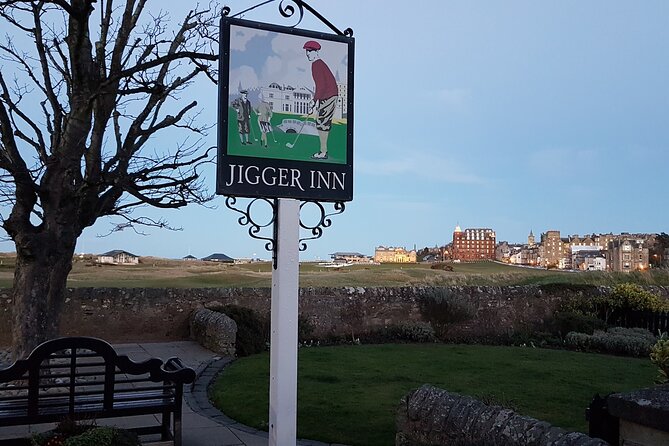
- Finish near the Jigger Inn: The tour ends by the Road Hole, where food and drinks are available at your own expense.
Golf history begins in the streets of St Andrews
The tour starts outside Hotel du Vin on The Scores, where Richard gives a short introduction to St Andrews and the town’s links charter of 1123. It is a useful opening because the Old Course did not appear in isolation. The town’s history and the links land are part of the same story, and this first stop gives you a bit of context before the golf takes over.
The introduction lasts about five minutes, so expect a quick orientation rather than a long lecture on medieval Scotland. Arrive on time: this is a shared public tour, and it will not wait for late arrivals. The start point is Hotel du Vin, 40 The Scores, St Andrews KY16 9AS.
From early stick-and-ball games to the Home of Golf
At the Links, the story reaches back to early forms of golf, including 13th-century stick-and-ball games in the Low Countries, before moving through the game’s development in Scotland. The guide explains the link between the early game, Edinburgh in 1744, and St Andrews’ place as the Home of Golf.
This section is especially useful if you know the modern game but not how it acquired its rules and customs. Rather than treating golf as a sport that simply sprang up on the Old Course, Richard connects its evolution to the places and people that shaped it. The stop lasts about ten minutes, and the information comes quickly, so listen closely if you want to retain the names and dates.
More golf trips in Edinburgh:
- St Andrews: Golf Origins and Old Course History Tour
★ 4.7 · 322 reviews - St Andrews Tours: Town, Golf and Old Course History
★ 5.0 · 138 reviews - Private St Andrews: Home of Golf Old Course Tour
★ 4.9 · 113 reviews
The R&A and the course features golfers take for granted
Near the Royal and Ancient Golf Club, the tour turns to how the Old Course changed alongside the game itself. You’ll hear about the development of fairways and bunkers, along with golf moments and figures such as Old Tom Morris. The old Caddie Shack also comes into the story.
This is one of the most valuable stops for golfers. Features that seem natural on any course today have their own history here, and the Old Course offers a real place to connect those choices to the game you play or watch. Richard’s years as a caddie help make the subject more than a string of course facts. Expect about 15 minutes here, with time for the stories to gather detail.
If you’re not a golfer, you can still follow the broader themes: how a sport develops, how a course changes to suit it, and how a local place becomes a worldwide reference point. But the golf-specific details will carry more weight if you already know the game.
Grannie Clark’s Wynd and the famous 18th
At Grannie Clark’s Wynd, the focus shifts to the Open Championship, the Dunhill Cup, and the Old Course’s development from 12 holes to 10 and eventually 18. The guide also points out sites around the 18th, where course history and major events come together.
This is not simply a scenic walk along a famous hole. The changing number of holes helps explain that the course did not arrive in its present form all at once. You get a sense of how the sport and its home course grew together, while the championship stories give you landmarks to look for as you walk.
The stop lasts around 15 minutes. If you follow golf closely, this stretch is likely to be a highlight. If you don’t, the course’s layout still gives the history a clear visual frame.
The first and 18th fairways, and a story about putting
The route continues toward Rusacks St Andrews and the shared first and 18th fairway. Richard talks about the farmers connected with the land, the hotel, the Mannings, and the original first tee and 18th hole. One particularly unusual story concerns early caddies and women, and how Old Tom came to create what is described as the world’s first putting green.
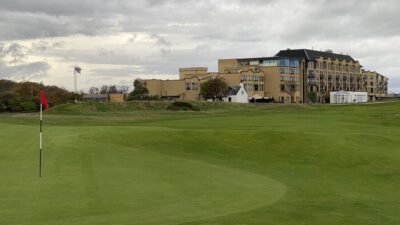
The first and 18th holes sit side by side at the heart of the Old Course experience. Seeing how the course begins and ends in the same space helps make its layout easier to understand, and gives you a sense of the action that gathers around these holes. This stop takes about ten minutes.
The fairway walk is a special part of the experience, but access can depend on what is happening on the course. One tour group was able to walk the course on a Sunday without interrupting play, but that is not a promise for every date. Follow any instructions from course staff and don’t step into active play.
More history tours in Edinburgh:
- Old Town Walking Tour History and Tales in Edinburgh
★ 5.0 · 2,168 reviews - Old Town Historical and Underground Tour
★ 5.0 · 1,574 reviews - Multi-Sensory Small-Group Historic Vaults Tour in Edinburgh
★ 4.5 · 1,384 reviews - Edinburgh Old Town: Historical Guided Walking Tour
★ 5.0 · 1,016 reviews
A photo at the Swilcan Bridge
The Swilcan Bridge is the tour’s most iconic photo stop. It is a familiar image in golf, but standing beside it gives you a better sense of its place in the route, between the first and 18th holes. The stop lasts about ten minutes, and professionally taken photos are included.
Tournament days are the important exception. The bridge photo opportunity is not available during events such as the Open or Dunhill, so check the date if this is a priority for you. Even without a formal photo, the stop still puts you at one of the Old Course’s best-known landmarks.
The bridge is also a natural pause in a tour packed with information. Richard has taken photos for groups and shared his own pictures, but don’t count on a long, unhurried photo session. The group needs to keep moving, and the tour’s pace is brisk.
Road Hole stories and the Jigger Inn finish
The final stop is by the Road Hole, the 17th, near the famed Jigger Inn. Here the guide tells stories about memorable moments around the 17th green before the tour wraps up. The stop lasts about ten minutes.
Finishing near the Jigger Inn is practical as well as atmospheric. You can stay for food or a drink beside the 17th fairway after the formal walk, though refreshments are not included. One guide helped a group find fish and chips nearby, but treat that as a useful tip rather than a planned part of the tour.
The tour information gives Swilcan Bridge as the end point, while the route description places the finish near the Jigger Inn by the Road Hole. In practical terms, expect to visit the bridge during the walk and finish near the 17th. If you have a tight onward plan, confirm the exact end point before setting off.
What $25 buys you
At $25 per person, the tour is a good-value way to put the Old Course in context. You’re paying for a local guide, a focused 75-minute walk, stories about the game’s origins and course development, and a guided look at landmarks that can be confusing if you simply wander around on your own.
The guide is the key value. The fairways and bridge are visible to the public when course activity permits, but it takes an informed storyteller to link what you see to the history of golf and the details of the course. Richard’s background as a caddie is a particular advantage for golfers who want more than a photo at a famous spot.
You also get professionally taken Swilcan Bridge photos, except on tournament days. The experience does not include food or drinks at the Jigger Inn, transport to St Andrews, or a round of golf. If you’re travelling from Edinburgh, remember that getting to St Andrews is separate from the tour price.
The tour is typically booked about 61 days ahead, so plan early if you have a fixed date. The price itself is modest, but the value depends on what you want: golf history and a guided walk, not access to play the course.
Pace, language, weather, and walking needs
The full walk takes about an hour and 15 minutes. The group can include up to 15 people, which is small enough for a more personal feel but still large enough that you may need to position yourself near the guide to hear clearly. One attendee found it helpful when the guide used earbuds, but don’t assume that equipment will be provided.
The guide may speak quickly, and the experience requires a fluent command of English. The operator specifically warns that translating or speaking slowly will not solve the language barrier. If you need frequent pauses to interpret, you may miss much of the commentary.
Wear warm layers and be ready for a change in weather. The coast can feel cold when conditions shift, and a past group found it useful to wrap up. The tour requires moderate physical fitness and is not suitable for children under five, strollers, crutches, walking frames, mobility scooters, or people with a recent knee or hip replacement, sprained ankle, or similar injury. There is nowhere to leave golf clubs or mobility equipment during the walk, so arrange storage elsewhere.
The tour operates in English and uses a mobile ticket. Service animals are allowed, and the meeting point is near public transportation. It requires good weather and a minimum number of people; if the operator cancels for either reason, you’ll be offered another date or a refund. You can cancel for a full refund up to 24 hours before the start time.
Who should take the Old Course history tour?
I’d choose this tour if you’re a golfer, a golf-history fan, or travelling with someone who is. It works well for mixed-interest groups too: the course and town history give non-golfers enough to follow, while the course details and caddie stories give golfers plenty to chew on. Several groups have included people with little or no golf knowledge alongside avid players.
It is less suitable if you want a slow, open-ended stroll or prefer a guide who pauses often for questions. Some people find the fast delivery engaging; others have felt that the guide followed a set spiel and did not leave enough room for questions. If you have trouble hearing in a group or need a slower pace, consider that before booking.
The tour’s strongest feature is the combination of place and perspective. You’re not just looking at the Old Course from the edge; when course conditions allow, you can walk across its fairway and hear how its holes, traditions, and famous moments fit together.
Should you book it?
Book the tour if you want a concise, story-led introduction to the Old Course and golf’s roots in St Andrews. For $25, Richard’s caddie perspective, the course landmarks, and the Swilcan Bridge stop make a strong case, especially if you’re already making the trip to town.
Skip it if you need a very slow-paced walk, cannot follow fast English, or want guaranteed access to the fairway or a bridge photo on a tournament day. For everyone else, it’s a smart way to turn a famous course into a place with a story, not just a backdrop.
FAQ
How long is the tour?
The tour lasts about 1 hour and 15 minutes.
Where does the tour start?
Meet Richard outside Hotel du Vin St Andrews, at 40 The Scores, St Andrews KY16 9AS.
Where does the tour finish?
The route finishes near the Road Hole and the Jigger Inn. The Swilcan Bridge is a stop along the way.
Is the Swilcan Bridge photo included?
Professionally taken photos are included, except on tournament days such as the Open or Dunhill.
How large is the group?
The tour has a maximum of 15 people.
Is the tour suitable for young children or people with mobility aids?
It is not suitable for children under five, strollers, crutches, walking frames, or mobility scooters. It is also unsuitable for some recent injuries or replacements, including new knee or hip replacements and sprained ankles.
Can I cancel for a refund?
Yes. You can cancel up to 24 hours before the experience for a full refund.
Newest tours in Edinburgh
- From Edinburgh: Outer Hebrides & Isle of Skye 6-Day Tour★ 4.7 · 33 reviews
- 8-Day Orkney Skye and Highlands Tour from Edinburgh★ 4.5 · 23 reviews
- 5-Day Orkney and Highlands Tour from Edinburgh★ 5.0 · 23 reviews
- Bannockburn Battlefield Tour★ 5.0 · 36 reviews
- Scotland: West Highlands, Mull and Iona 4-Day Tour★ 4.5 · 13 reviews
- From Edinburgh: Isle of Skye and Outer Hebrides 6-Day Tour★ 4.9 · 17 reviews
- St Andrews and Falkland Palace Tour from Edinburgh★ 4.8 · 27 reviews
- 4-Day Magical Mull, Iona & West Highlands Small-Group Tour from Edinburgh★ 5.0 · 37 reviews
St Andrews Golf Tours, compared.
St Andrews Tours: Town, Golf and Old Course History
Read our review →
Browse the lists this tour appears in